
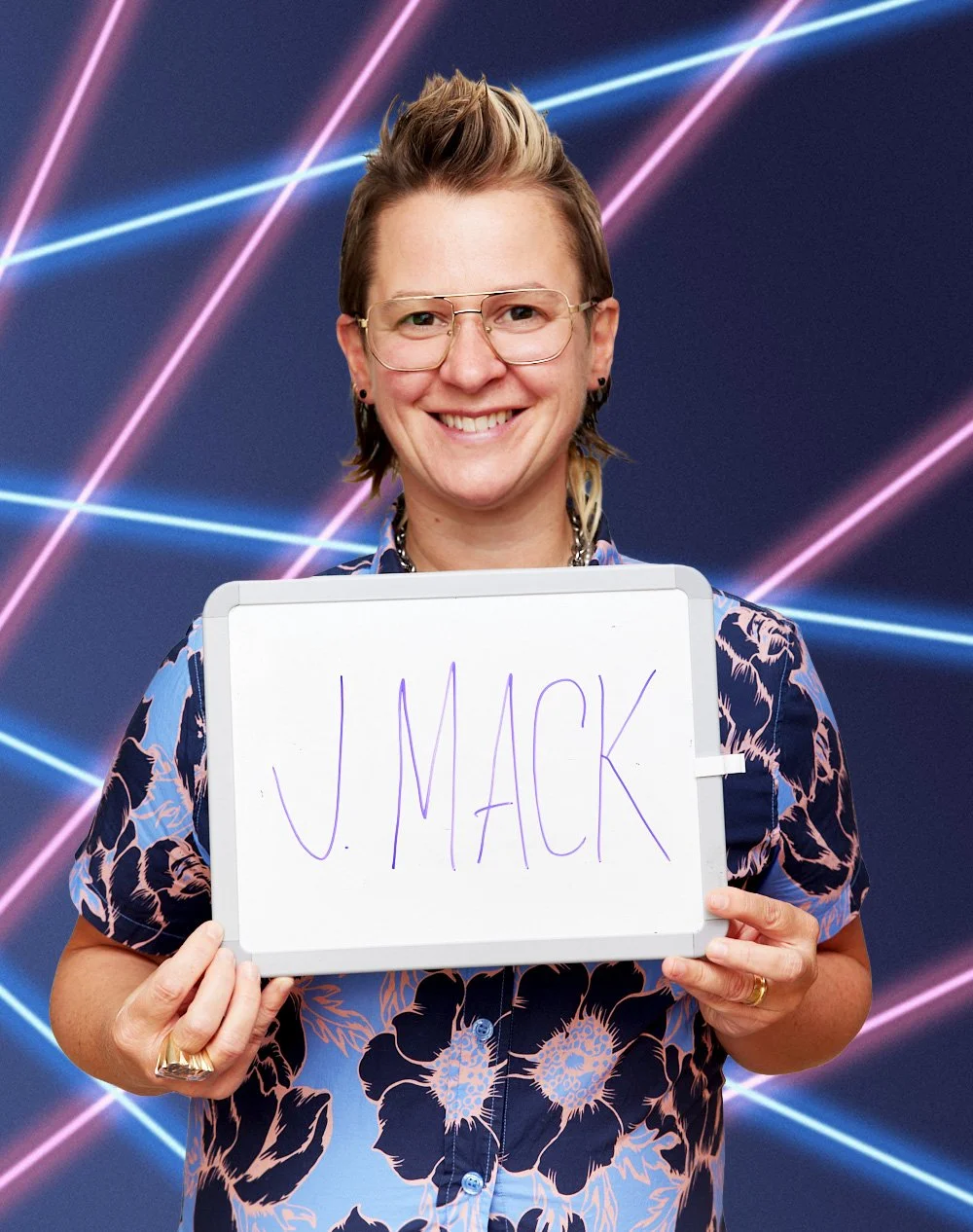
Untitled (Laser Background/New Branding), 2026
Bio
Julie Mack — who goes by J. Mack (she/they) — is a Brooklyn-based artist whose constructed photographs examine family mythology, domestic performance, whiteness, queerness, and the visual codes through which American normalcy is staged and believed.
Born in suburban Detroit in 1982, J. Mack received a BFA in Photography from Parsons School of Design and the Tierney Fellowship in 2005. Her early work, exhibited as Julie Mack, included solo exhibitions at Laurence Miller Gallery in 2007 and Kresge Art Center at Michigan State University in 2011. Her work has been presented at the Venice Biennale, Art Basel, Paris Photo, and ARCO Madrid, and in exhibitions at the Museum of Fine Arts, Boston; the Arkansas Museum of Fine Arts; the Addison Gallery of American Art; the John Michael Kohler Arts Center; and the Weatherspoon Art Museum. Her photographs are held in the permanent collection of the Museum of Fine Arts, Boston, and her work was shortlisted for the Paris Photo Prize for Contemporary Photography. She is a 2026 Critical Mass Top 200 finalist. Her photographs have appeared in LIFE, including a cover, as well as The New York Times, Time, New York Magazine, and Condé Nast publications.
From 2005 through 2024, J. Mack built a nearly twenty-year career spanning art direction, documentary and commercial production, and creative leadership, in parallel with her fine-art practice. She returned to full-time studio practice in 2025.
Her primary body of work, Evidence & Fiction, brings together more than two decades of constructed portraits of the white, middle-American family she was born into, the family she entered through her partner, and the queer chosen family she has made. As a gender-nonconforming queer artist working both inside and outside these systems, she is inside the room but outside the script: implicated in the families she photographs, never fully absorbed by them.
The work treats the family photograph as evidence, fiction, and agreement at once: a record of real people, a staged image of belonging, and a contract about how a person is allowed to appear.
Working primarily with medium- and large-format film, J. Mack photographs multiple versions and pieces the frames into cohesive but unstable compositions. She is now sequencing Evidence & Fiction toward a photobook and exhibition. The argument lives in the order of the pictures.